Royal Netherlands Meteorological Institute; Ministery of Infrastructure and the Environment

 
Research
Climate Research
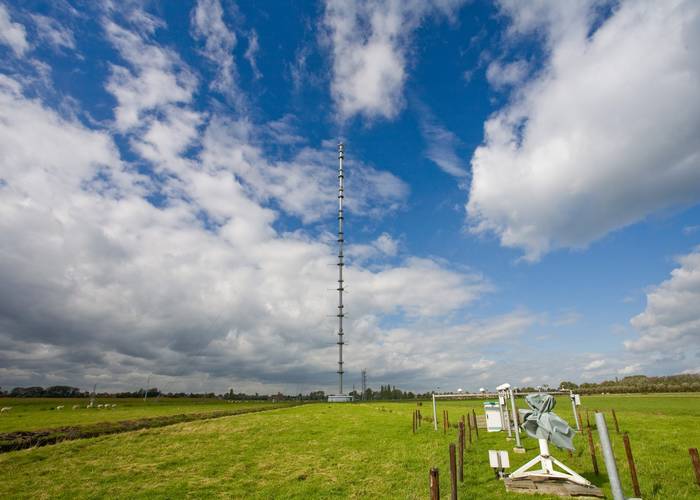
The Cabauw Experimental Site for Atmospheric Research (CESAR): the 213m mast and radiation site
KNMI provides advanced scientific knowledge, observations and advice on the global climate system, substantiating the efforts of the Dutch government (or governmental organizations) to protect The Netherlands to the impacts of climate and climate change. KNMI assures the high quality of its activities by participating in the national and international climate research efforts.

KNMI's climate activities are carried out for an important part through international cooperation, on an appropriate high-level, to ensure the availability of state-of-the-art, high-quality results and to maintain the international stature and visibility of The Netherlands. Climate research and monitoring is necessarily a global undertaking to which developed countries like The Netherlands and its national meteorological institute choose to contribute as part of its international policy. KNMI contributes to international efforts on climate monitoring and modeling via the following international bodies: IPCC, WMO, GMES, GCOS.

KNMI's climate activities aim to:
  • construct state-of-the-art climate scenario's for the Netherlands and support its use;
  • maintain and improve long-term, high-quality local and global climate monitoring capabilities, adhering to the GCOS guidelines;
  • provide leading and substantial contributions in the future assessments supporting climate policy (IPCC);
  • lead the development and utilization of community climate system models;
  • perform research on the critical issues that currently limit the ability to predict future climate on the global scale;
  • perform essential process and modelling studies needed to understand climate change and its predictability;
  • provide input for adaptation, mitigation and geo-engineering.

KNMI's Climate Research is carried out in five divisions:
  • Climate Observations: satellite observations of the atmospheric composition, for application in research on climate, air quality, and stratospheric ozone.
  • Chemistry and Climate: quantify, understand and predict anthropogenic and natural changes in atmospheric composition and their consequences for climate, air quality and ultraviolet radiation.
  • Climate Services: provides knowledge and information on past, current and future climate.
  • Global Climate: study of large-scale climate variability, including the effects of climate change.
  • Regional Climate: model development, observations and fundamental research to address current issues in climate research on the regional scale.

Back to research