

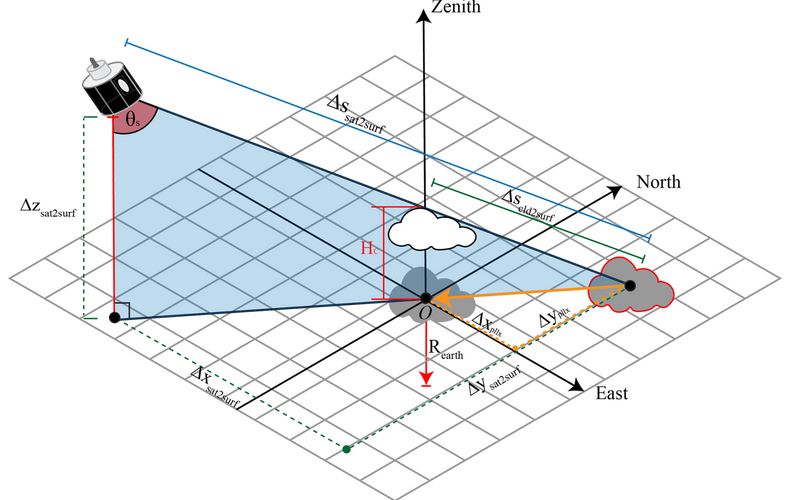
Satellite-derived global horizontal irradiance (GHI) is an excellent data source for nowcasting solar power generation and validating weather and climate models. To obtain a good match between satellite-derived GHI and surface observations of GHI, precise geolocation of the satellite GHI is an essential factor in addition to the accuracy of the retrieval. The geolocation of satellite retrievals is affected by parallax, a displacement between the actual and apparent position of a cloud, as well as by a displacement between the actual position of a shadow and the retrieved position of the shadow, which, due to the one-dimensional (1D) radiative transfer assumption, is directly below the cloud. This study evaluates different approaches to correcting Meteosat Spinning Enhanced Visible and Infrared Imager (SEVIRI) retrievals for parallax and cloud shadow displacements using ground-based observations from a unique network of 99 pyranometers deployed during the HD(CP)2 Observational Prototype Experiment (HOPE) field campaign in Jülich, Germany, in 2013. The first method provides geometric corrections for the displacements calculated using retrieved cloud top heights (Hc). The second method relies on empirical collocation shifting. Here, the collocation shift of the satellite grid is determined by maximizing the correlation between the satellite retrievals and ground-based observations. This optimum shift is determined either based on daily or time-step-averaged correlations. The time-step-averaged collocation shift correction generally yields the most accurate results, but a major drawback of this method is its reliance on ground measurements. The geometric correction, which does not have this disadvantage, achieves the most accurate results if a combined parallax and shadow correction is performed. It reduces the GHI root mean square error (RMSE) by 11.7 W m−2 (10.8 %) compared to the uncorrected retrieval. Separate parallax or shadow corrections do not reach this level of accuracy. In fact, depending on the cloud regime, they may even increase the error compared to the uncorrected retrieval. In some cases, particularly when multilevel clouds are present, the retrieval accuracy improves if the geometric correction is based on a reduced Hc. Finally, it is demonstrated that GHI becomes increasingly sensitive to the applied correction at higher spatial resolutions, especially for variable cloud regimes. This has important implications for the retrieval accuracy of the current generation of geostationary satellites with spatial resolutions down to 500 m.
Job I. Wiltink, Hartwig Deneke, Chiel C. van Heerwaarden, and Jan Fokke Meirink. Evaluating parallax and shadow correction methods for global horizontal irradiance retrievals from Meteosat SEVIRI
Journal: Atmospheric Measurement Techniques, Volume: 18, Year: 2025, First page: 3917, Last page: 3936, doi: https://doi.org/10.5194/amt-18-3917-2025