
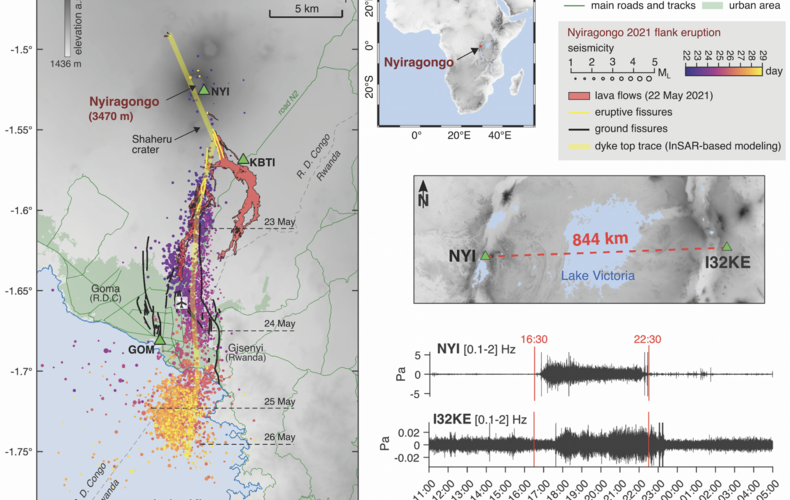
Eruptions at continental basaltic volcanoes can take and combine various forms, including lava lakes, lava flows and fountaining, explosions or structural collapses. Aside from a few well-instrumented cases worldwide, accurately reconstructing eruptive scenarios is hampered by the lack of detailed visual observations. However, volcanoes also have their own acoustic signatures composed of low-pitched inaudible sounds, called infrasounds. Here we analyze infrasound records close to Nyiragongo volcano (D.R. Congo) ( <20 km) up to Kenya ( ~800 km), which are converted using acoustic numerical modeling into time-lapse observations of the catastrophic drainage of the world’s largest lava lake on 22 May 2021. The emitted infrasounds also enable tracking of fissure openings and lava eruptions along the flank, occurring simultaneously with the lava lake drainage. This striking example supports the growing role of infrasound as a key component of volcano monitoring and early-warning systems, as it provides unique information inaccessible to other ground-based instruments.
J Barrière, A Oth, JD Assink, N d’Oreye, LG Evers . Infrasound reveals detailed eruptive processes at Nyiragongo volcano and enhances monitoring capabilities during unrest periods
Journal: Nature Communications Earth & Environment, Volume: 6, Year: 2025, doi: 10.1038/s43247-025-02937-3